


EPI and DOTS Survey Analysis Report
ASUCD Innovation and Research Lab
Primary Contributors: Jeremy Elvander, Associate Director; Isabella Gonzales, Researcher; Meenakshi Iyer, Researcher; Brady Horton, Researcher
External Contributors: DOTS — Ramon Zavala, Transportation Demand Manager, Equitable Parking Initiative — Siddharth Jasthi, Chairperson; Alex Jackson, Executive Chief of Staff
Introduction & Objectives
This report provides an analysis of transportation and parking behaviors at UC Davis. This study aims to identify key trends influencing student, faculty, and staff commuting decisions, with a particular focus on convenience, safety, cost, and accessibility. The findings highlight the motivations behind driving to campus, preferred parking locations, and the financial implications of commuting, ultimately guiding recommendations for a more equitable and efficient mobility system at UC Davis.
Data Exploration and Analysis
Our data analysis started with looking at bar charts of driving patterns. We looked at how frequently people drive to and from campus, and how long it takes them to travel from their residence to campus. The first graph is a distribution of commute times depicting that it takes the majority of respondents between five to nine minutes to get to campus. The next most common timeframe was 10 to 19 minutes. The data is skewed to the right, meaning that only a few respondents have longer commute times, and most are clustered between five to 19 minutes.

Additionally, 273 respondents indicated that they drive to campus on a daily basis, and 197 respondents drive to campus on a weekly basis. This constitutes about 85.8% of responses, meaning the large majority of respondents are frequent drivers. On the other hand, 183 respondents agree that they should make personal changes to reduce their carbon footprint, while 174 respondents are neutral about it. We found that most people who drive to campus either do not carpool with anyone or carpool with only one person. Approximately 12.8% of respondents carpool with two or more people when they drive to campus.

220 respondents said that they agree or strongly agree they should make personal changes to reduce their carbon footprint. Many of these same people would likely support DOTs parking fees and practices more if they understand the motivation behind them. One of DOTs’ main goals is to decrease emissions by limiting drive-alone commuters. The majority, however, do not feel strongly that they should make personal changes. 58.8% of respondents are either neutral, disagree, or strongly disagree.

The majority of respondents would choose alternative transportation options if they were more affordable or available, however availability seems to be the more limiting factor. 318 respondents agreed or strongly agreed that they would choose alternative transportation options if they were more available in comparison to the 268 who selected agree or strongly agree when referring to affordability.

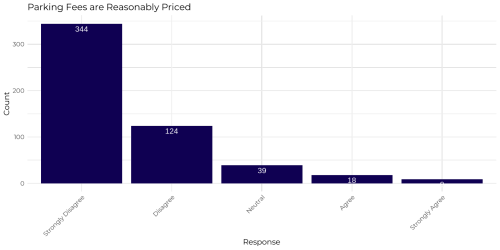
Approximately 87.6% of respondents strongly disagree or disagree that parking is reasonably priced. 344 strongly disagree that parking fees are reasonably priced, which is more than double of 124, the number who disagree. Such a strong skew to the right suggests that the majority of respondents have similar opinions regarding the price of parking fees.
Key Findings
Finding #1: Most people drive to campus for convenience, with safety and work being recurring self-inputted reasons.

As shown in the above figure, the most commonly cited reason for driving to campus is convenience, with 397 responses. This is trailed by weather, distance from campus, and lack of alternative transportation options, with 295, 243, and 157 responses respectively. When individuals chose “other” as a response, safe transit at night and tight work schedules were commonly cited reasons, with 16 and 10 responses respectively.
Finding #2: The Memorial Union Garage is the most popular place to park on campus, followed by Hutchinson Garage and the Arc Lot.

The Memorial Union Garage is the most popular place to park on campus, with 317 respondents citing it as their preferred location to park. Hutchinson Garage and the Arc Lot were close behind, with 270 and 234 respondents, respectively. These three locations far outpaced the other six lots, as the next closest amount of responses was the Dorm Lots with 114 responses. The least parked at lots were the Rec Pool Lot and the Medical Sciences Building Lots, which makes sense considering their distance from high demand areas of campus.
Finding #3: Students frequently spend $13.5 a month on gas driving to campus.

Using the values of distances from campus and the frequency of parking for each survey respondent we estimated the monthly cost of driving to campus. This was estimated using the national mpg average, 26 mpg, and the current California average gas price, $4.4. The average cost was $51.34 per month however, due to the skewed nature of the data the median of $13.5 is a better measure of center. This distribution reflects the distribution of distances from campus. The majority of people live within 10 miles of campus, with a median of 4 miles. This data is displayed in a histogram that can be found in the appendix.
Finding #4: Regardless of the number of citations they received, the majority of respondents strongly disagree that parking fees at UC Davis are reasonably priced.

87.64% of respondents (excluding NA values) strongly disagree or disagree that parking fees are reasonably priced. When considering the number of parking tickets respondents received that could potentially affect their opinion, we found that over 50% of respondents for each citation count group strongly disagree with this statement. Out of the 210 respondents who have not received a citation, 121 of them fall into the ‘Strongly Disagree’ category, making them the largest group count-wise, but smallest group proportion-wise.
Finding #5: Self-selected knowledge level on DOTs is not an accurate indicator of true knowledge of DOTs.

When asked to rate their understanding of DOTs' structure, funding, responsibilities, and purpose, 119 respondents chose Very Uninformed, 106 chose Slightly Uninformed, 108 chose Neither Uninformed Nor Informed, 142 chose Slightly Informed, and 33 chose Very Informed (Appendix Figure A & D). 40 NA values for the first three questions were omitted from the analysis. The fourth question had 60 NA values, bringing the totals for each category to 114, 103, 103, 135, and 38 respectively.
Question | Answer |
DOTs is funded by tuition and other state funds. | False |
DOTs is responsible for programs like the Causeway Connection. | True |
DOTs aims to limit the amount of drive-alone commuters. | True |
A monthly pass is more cost effective than daily parking for most students. | False |
The answers to the questions regarding DOTs’ funding and the cost effectiveness of monthly passes are both False, but the majority of respondents incorrectly chose True. The answers to the questions about the Causeway Connection and limiting drive-alone commuters is True, and the majority of respondents correctly chose True.

Regardless of which information level they chose, respondents got the same questions correct and incorrect overall. For the first question, 24 to 25% of respondents in the first three categories answered correctly, while approximately 39% in the ‘Slightly Informed’ category and 48% in the ‘Very Informed' category answered correctly. However, for the second question, only 61% of respondents in the ‘Slightly Informed’ category answered correctly, which is lower than all other categories. 85% of ‘Very Informed’ respondents were correct for the third question, but so were 85% of ‘Slightly Uninformed’ respondents. Finally, less than 22% of respondents in each category were correct for the last question regarding monthly passes. It is worth noting that a monthly pass becomes more cost effective than daily parking after driving to campus for a certain threshold of days, but the majority of respondents indicated that they drive to campus daily or weekly. Overall, the proportion of people in each information level who chose True or False has no obvious indication that a higher proportion of those who said they better understood DOTs actually did compared to those who said they were more uninformed.
Finding #6: The majority of respondents would be interested in volunteering to pay off citations.

Most of the respondents, 54.9%, would be willing to volunteer to pay off citations.
Conclusion & Recommendations
In conclusion, most people drive to campus on a daily or weekly basis and do not carpool, yet they do not feel strongly about making personal changes to reduce their carbon footprint, suggesting that convenience often outweighs sustainability concerns. While affordability plays a role in transportation choices, respondents indicated that they would be more inclined to use alternative transportation options if they were more widely available rather than just more affordable, highlighting the need for improved infrastructure and accessibility. The primary reason for driving to campus is convenience, with many students and faculty prioritizing flexibility and time efficiency over cost or environmental impact. Among parking locations, the Memorial Union Garage, Hutchison Garage, and ARC Lots are the most frequently used, reflecting their proximity to key campus areas and their higher capacity compared to other parking options. Despite the regular use of personal vehicles, the monthly gas expense for commuting to and from campus remains relatively low for most individuals, likely due to the short average distance traveled. However, dissatisfaction with parking policies is widespread, as the majority of respondents believe that parking fees are unreasonably high, regardless of whether they have received a citation. Lastly, while many respondents claim to have a solid understanding of DOTs, the data suggests a significant gap between perceived and actual knowledge, indicating a need for greater transparency and education on transportation policies and campus mobility options.
We present the following recommendations:
- Remove obstacles associated with carpooling in Davis. While many students note that they drive to campus out of convenience, they also indicate a strong desire to reduce their carbon footprint. Perhaps opening up a carpool portal to connect students who are traveling to campus would help achieve this goal. Platforms like Moober by AggieWorks may be able to help with this implementation.
- Consider adding more volunteer options or alternatives to a parking fee. According to DOTs, citations are not a significant revenue source, so this option could make parking more equitable for students whilst not drastically reducing DOTs’ revenue. This would also help students contribute to the UC Davis community, and potentially DOTs’ goals, without substantially impacting their livelihood.
- Increase awareness of DOTs’ purpose and goals. Many students have a negative perception of DOTs’ whilst not having a complete picture of what the organization hopes to achieve. If DOTs had more proactive education surrounding their contributions and initiatives, students may view the organization in a more positive light and perhaps be more amicable to changing their behavior to contribute to the organization’s goals.
Appendix
Appendix A: Supporting Figures


